
AI Risk & Limitations — Part 3: Hallucinations
Most professionals picture an AI hallucination as a fabricated citation. The category is broader and more subtle — and the subtler forms are the hardest to catch.
Published May 18, 2026
In legal and medical-legal practice, the term "AI hallucinations" tends to summon one image: an AI tool inventing a citation that does not exist, fabricating an event or date, or quoting language absent from the record. That narrow view captures a genuine and serious failure mode. Yet the full category of hallucinations is broader and more subtle — and the subtler forms can be the most difficult to catch precisely because the output reads as plausible.
The Ethical & Safe AI Adoption Checklist from Case Chronology® places "Overcome Hallucinations" among the central limitations that any responsible AI solution must address on real-world records. The checklist acknowledges the obvious risks — fiction content, links issues, association mistakes — but also points to the quieter failures that can undermine a defensible opinion even when every cited sentence appears to trace to a document.
The Broader Reality of Hallucinations
Most professionals in litigation and medical-legal work first think of hallucinations as outright invention: events that never happened, dates that do not align with the record, names or quotations that the documents never contain. Those failures are real and well-documented.
The category extends further. An AI response may be factually drawn from a document and still be the wrong document for the part of the opinion at hand. The cited passage may be accurate in isolation yet pulled from its surrounding context in a way that changes its meaning. The model may associate unrelated facts or overlook nuance, ambiguity, or hedged language that an expert would immediately flag.
Other forms surface as well. Training bias or alignment heuristics can tilt the output away from the case's actual posture. Manipulation tactics embedded in discovery material — hidden instructions or adversarial content — can steer the response. Prompt or session-state dependencies can produce inconsistent answers to the same question. And the model may simply fail to account for missing documents, near-duplicates filed under the wrong heading, or records that OCR and initial AI processing miss because of poor scan quality, faded handwriting, or non-standard formatting.
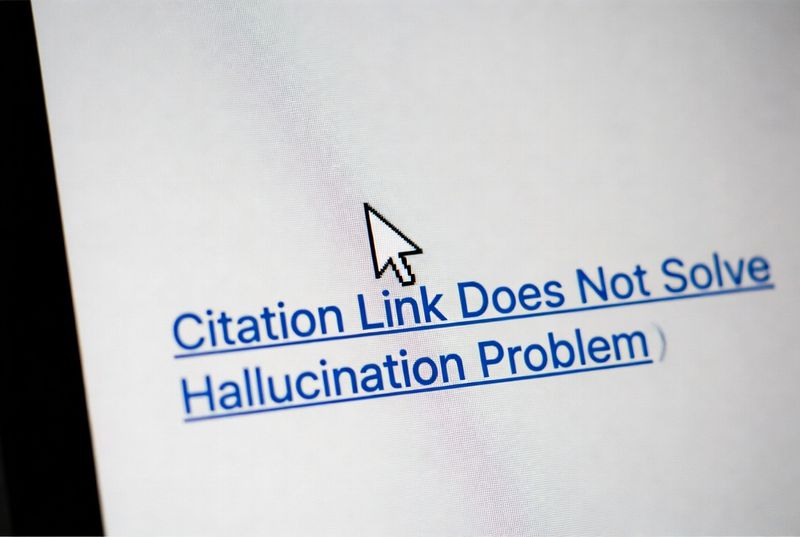
In each instance the output may carry a source link. Yet a source link alone does not establish that the document is the most relevant one for this portion of the opinion, nor does it confirm that the citation survives scrutiny when read alongside the rest of the record. That is the deeper limitation the checklist highlights: factual correctness from a document is not the same as defensibility in the full context of the case material.
Why a Source Link Is Not Enough
A clickable reference satisfies the narrow test of "does this document exist and say what the AI claims?" It does not answer the questions an expert must still ask before the opinion can stand:
- Is this the most relevant source for the specific point being made?
- Does the surrounding record change the meaning or weight of the cited passage?
- Are there gaps, inconsistencies, or clusters elsewhere in the timeline that the AI output has not surfaced?
- Have important records been overlooked because of quality issues or filing anomalies?
An opinion built solely on isolated, correctly linked excerpts may still fail under cross-examination, peer review, or the individual medical and legal decisions that depend on the underlying analysis. The record must be interrogated from multiple coherent angles before the opinion can be trusted.
How Case Chronology® Makes AI Defensible
Case Chronology® was built the other way around. Its Validation Tool Suite — Workspace Analysis filters, Timelines, Calendars, Reports, AI Workflows, AI Chat, and Search — supplies the Enhanced Context that turns a source link into a validated contribution. The same instruments an expert uses to test their own working theory also test every AI output against the validated documents and the larger picture those documents form.
Filters let the expert slice the record by party, issue, date range, or custom dimension and immediately see whether the AI's claim holds when the lens shifts. Timelines and Calendars surface sequence, clusters, gaps, and overlaps that no single document would reveal. Reports expose whether every claim remains traceable once placed in the full chronology. AI Workflows and AI Chat generate labeled, reviewable contributions that the expert can then validate directly against the underlying material. Search confirms coverage and flags the absences that matter.
When documents contain handwriting, poor scans, or filing anomalies, the platform treats coverage as a human-plus-AI review rather than an automation-only exercise. The expert's eye remains on the records that matter most. Prompt management surfaces in the structured Prompt Hub, and the ability to rerun workflows makes model-version changes auditable rather than invisible.
The result is accountability for AI that matches the accountability experts already demand of their own work. Every contribution — human or AI — is labeled, reviewable, and tied to source. More importantly, the suite goes beyond the link to confirm relevance and contextual integrity. AI does not power Case Chronology® — Case Chronology® is what makes AI defensible.
A Verified Opinion You Can Trust
The volume of material in modern matters continues to grow, and AI accelerates both the generation and the consumption of that material. The temptation is to accept a plausible summary and move on. The platform exists to make the harder path — independent judgment at scale — the easier one.
By surfacing consistencies and inconsistencies across multiple coherent views, Case Chronology® helps experts form opinions that hold up under trial scrutiny, peer review, and the individual medical and legal decisions the analysis informs. The source link is a beginning. The Validation Tool Suite and the Enhanced Context it builds are what turn that beginning into a verified opinion you can trust.