
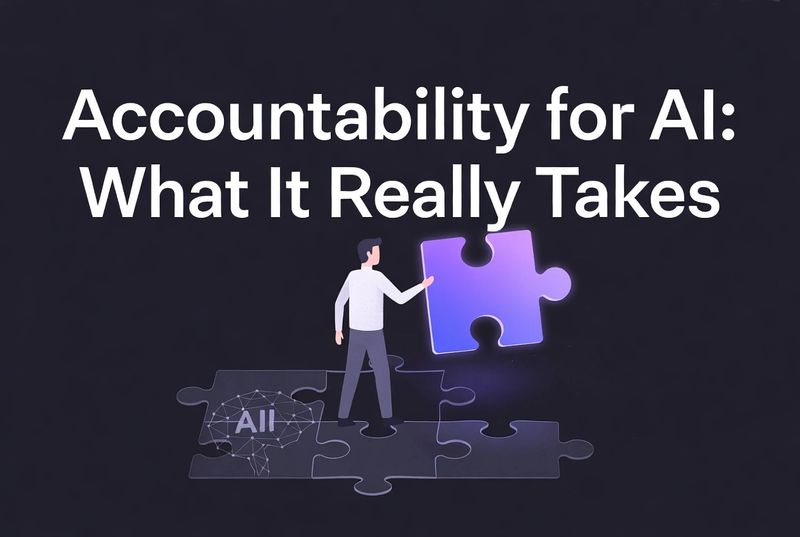
AI Risk & Limitations — Part 2: Accountability for AI: What It Really Takes
Most individuals and organizations beginning their AI journeys underestimate how complex AI accountability actually is
Published May 15, 2026
Most AI journeys begin with the wrong question
Across industries, the conversation about AI adoption tends to start in the same place: what can AI do for us? It is a reasonable starting point. AI can do a great deal. But in legal and medical-legal work — where the output of the analysis is an expert opinion that must survive trial cross-examination, peer review, and the individual medical and legal decisions that depend on it — the more important question comes immediately after: what can AI get wrong, and how will we know?
Most people beginning their AI journeys have not yet asked that second question with the seriousness it deserves. That is not a criticism. It reflects where the market is. AI adoption is accelerating faster than the frameworks for evaluating it, and most organizations are learning as they go. In lower-stakes environments, learning as you go is acceptable. In legal and medical-legal work, where a failure in the AI’s output can surface in cross-examination or fail peer review, it is not.
At Case Chronology® we could not afford that posture. The platform has been used by expert witnesses, treating physicians, IME examiners, life-care planners, and litigation teams to form and defend opinions in thousands of trials. When we evaluated whether and how to introduce AI tools, the standard was not whether AI could save time — it could, and it does. The standard was whether every AI contribution could survive the same scrutiny as every human contribution: fully traceable, fully reviewable, defensible from the case material up.
What that evaluation revealed is that AI accountability is considerably more complex than the market has been willing to say plainly.
The risks are real, and there are more of them than most realize
The Ethical & Safe AI Adoption Checklist — available at casechronology.com/ai-checklist — was developed as the authoritative framework for evaluating AI in legal and medical-legal work. It organizes risk across six categories: Trust, Security, Disruption, Cost, Overcome AI Limitations, and Usability. The largest category alone covers fourteen specific items. That scale is itself a signal: responsible AI adoption in this field is not a configuration exercise. It is a sustained commitment to understanding what AI gets wrong and building instruments capable of catching it.
The risks most people are aware of — hallucination, data privacy, outright fabrication — are real and significant. But they represent only a portion of what demands attention. Training bias shapes how a model reads case material before a single document is processed, reflecting prior assumptions about jurisdictions, clinical standards, and case posture that may have nothing to do with the matter at hand. Alignment bias pushes AI toward clean, confident summaries at exactly the moments when nuance, contradiction, and hedged language are what the expert needs to find. Prompt opacity means an expert who cannot see how the AI was instructed cannot evaluate whether the output reflects the case or reflects the vendor’s engineering choices. AI manipulation — hidden instructions embedded in discovery productions or exhibit sets — can redirect a model’s output in ways that are nearly impossible to detect without deliberate validation against the source documents.
And underlying all of it is the risk that receives the least attention in most AI conversations: the loss of critical thinking. An expert who accepts AI output without interrogating it has not saved time on analysis. They have replaced analysis with a plausible-sounding substitute — one whose failures will surface not in the office, but in cross-examination or peer review.
This series will address each of these risks in depth, one post at a time. The purpose here is not to catalog them exhaustively but to establish the scope of what accountability for AI actually requires — and why most platforms that call themselves “AI-powered” address little of it.
What Case Chronology® built to address it
When Case Chronology® introduced AI tools to the platform, the decision was to build them into the existing validation architecture — not alongside it, not as an alternative to it, but governed by the same standard as every other instrument in the suite. The result is a comprehensive set of tools that gives expert users everything they need to incorporate AI safely and ethically into the work of forming a verified opinion.
The human validation instruments — Workspace Analysis filters, Timelines, Calendars, Reports, and Search — were built and proven long before AI entered the platform. They are the foundation. They build the Enhanced Context of the case: the picture that comes not just from what individual documents say, but from how the full record behaves across time, party, source, and issue — where it confirms the working theory and where it contradicts it.
AI Workflows, Prompt Hub, AI Chat, and AI Validating AI were introduced into that foundation — governed by the same validation standard, traceable to the same case material, and subject to the same human review. Every AI contribution is labeled. Every output is tied to source. Every prompt is visible and auditable. And where AI is used to check AI, the Enhanced Context the expert built is what the checking works against.
The result is not a platform that added AI and hoped for the best. It is a platform whose independent analytical rigor — the rigor that produces a defensible opinion without AI — is precisely what makes AI’s contributions defensible when they are used.
The inversion that matters
Case Chronology® is not dependent on AI. AI is dependent on Case Chronology®.
AI needs the Enhanced Context the platform builds — the validated documents, the structured timelines, the filtered analysis, the visual pattern of the calendars — to produce output that is relevant, not just accurate. It needs the Validation Tool Suite to be held accountable. It needs the human expert, working with instruments designed for the purpose, to examine what AI proposes before it becomes part of a verified opinion.
Without that foundation, AI on a real-world case record is leveraged exposure — powerful and unaccountable. With it, AI becomes what it should be in this work: a capable instrument that a rigorous expert can use, examine, and defend.
That is what accountability for AI means in practice. The posts ahead will show exactly how each risk is addressed — one item at a time, at the depth the work demands.
---
Case Chronology® — A Verified Opinion You Can Trust. Accountability for Humans. Accountability for AI.
Ethical & Safe AI Adoption Checklist: casechronology.com/ai-checklist